The joy of figuring out how software works may be lost

This was beautiful to read - the joy of understanding how something works, reverse engineering a piece of software or debugging something for hours and the joy of "figuring it out" is something that might become a lost art in the decades to come.
I feel this will cause us to spend a lot more time introspecting - what do we really want, dig into the motivations behind our want and the guardrails around what are we ok with.
- Coding agents
Keep reading
Newer: A cell built from scratch grows and dividesModels and research
Meta Brain2Qwerty and a society with mind-reading devices
How would society function when mind-reading devices are built into your glasses and phones? I am thinking of starting to train my mind to "think" in an encoded language that I come up with. But then again, LLMs can likely decipher that too! ai.meta.com/blog/brain2qwerty-brain-ai-human-commun…
Software architecture
AWS Lambda introduces MicroVMs for isolated sandboxes
AWS releases MicroVMs - run isolated sandboxes. Excited to try this - I hope they don't run into AWS Lambda cold start issues. You get virtual machine level isolation, near-instant launch and resume, and direct control over environment lifecycle and state. aws.amazon.com/blogs/aws/run-isolated-sandboxes-wit…

Forward deployed engineeringPlank
Training the next generation of FDEs and AI engineers
Excited about training the next generation of FDE and AI engineers at Plank! The way we build software is changing every few months and the only way businesses can keep up is with on-going training of team members. The way you built 6 months ago is already LEGACY.
Coding agents
PostHog's 70x faster SQL parser built with Claude Code
Robbie Coomber from PostHog rewrote PostHog's SQL parser using multiple long-running Claude Code sessions in parallel. The result was 16K lines of "hand"-rolled parser code, 5K lines of tooling, a few more K of tests, and a ~70x speed up! Thats awesome. There really is no excuse to not ask Claude or Codex to optimize your codebase. Of course it requires providing the right evals and harness so that it has a way to measure correctness in an objective way. Also I love that they have a formal declarative grammar for the parser using ANTLR .g4 format. Read more here: posthog.com/blog/sql-parser

Software architecture
Microsoft pg_durable and keeping everything in the database
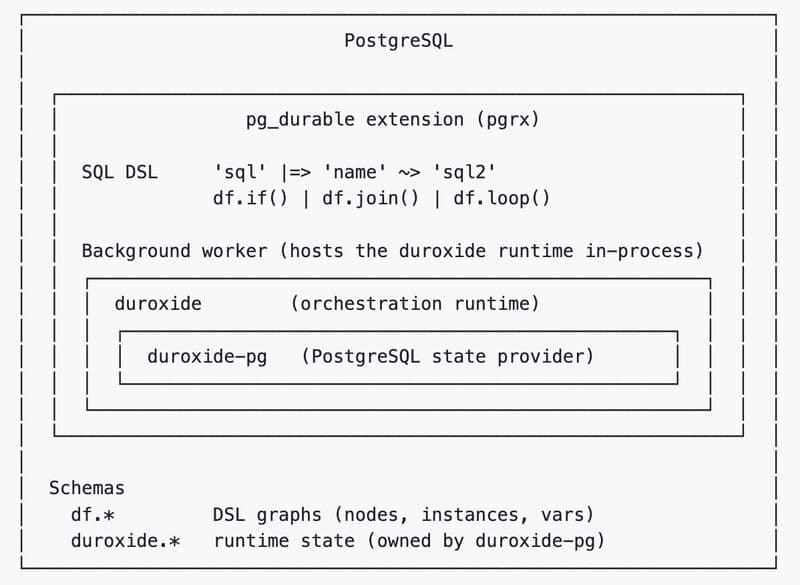
Microsoft open sources pg_durable - this allows durable task execution within PostgreSQL. I personally really like the pattern of keeping everything within the database and avoid external queues, multiple databases to manage state, locks etc. Every additional architecture module introduces complexity that might not be needed. In most applications if you keep everything within the DB, it makes each individual flow fast, clean, contained. And re: scaling, just scale vertically and then shard as needed. That works for most b2b apps. github.com/microsoft/pg_durable
Coding agents
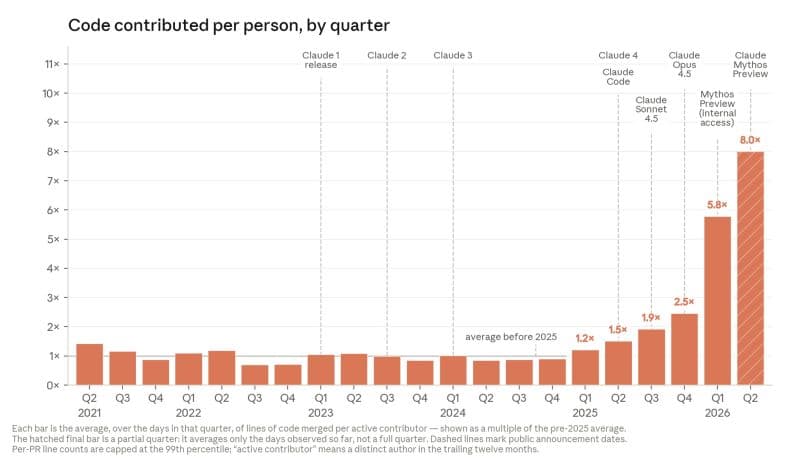
Anthropic engineers now ship 8x as much code per quarter
The amount of software in the world is at the cusp of a Cambrian explosion. Today, Anthropic engineers on average ship 8x as much code per quarter as they did compared to 2021-2025.
Models and research
Opus 4.8 sets a new state of the art on ARC-AGI-3
Opus 4.8 is new SOTA on ARC-AGI-3! It was fun to help contribute to the open source benchmark harness for running this eval. Github repo: github.com/arcprize/arc-agi-3-benchmarking x.com/arcprize/status/2061512025638121516

Models and research
Anthropic is already profitable on inference unit economics
Anthropic is already profitable on inference unit economics. anthropic.com/news/confidential-draft-s1-sec