Claude Code needs an army of cloud sandboxes

While Claude Code is amazing as a tool on developer desktops, there feels this need to have an army of cloud sandboxes where you would want to run multiple concurrent codegens and the desktop is just playing the orchestrator role. Further, this would allow these sandboxes to also have things like browser-use and desktop-use access.
- Coding agents
Keep reading
Newer: An open source fix to cmux for respawning agent teamsCoding agentsSoftware architecture
Source control should capture prompts alongside code
There seems to be a gap in modern source control systems like git where the human programmer’s prompts are not captured as part of the code. The series of prompts given by the engineer, as well as the output from those should also be a part of the pull requests. This would allow automation to re-run those prompts whenever there’s a new version of the coding models and automatically improve code quality.
AI agentsCoding agents
Self reflection in agents and prompt-based programming
Self Reflection in Agents - 01 I started my coding life using an esoteric functional programming language - SML (its still my first love). I fell in love with programming many times over as I went on to build in Python, assembly C, C++, SQL, Ruby, Java, Typescript, and many more. Now that I have been doing prompt-based agentic programming, it is clear to me that just like other languages/frameworks, one needs to create mental models of the structures in this new language. There is no substitute but to spend many, many cycles of deep meditative flow states to develop the intuition of what this new language is good at, where it needs more specification etc. Which has gotten me to think about self reflection - not just from a personal pov :) but also about how this applies to agents, and how it’s the next frontier for software development. Programming will become even more cerebral, where you ponder - what are the few words you can add to your prompt to inspire your agent, to have it ever so slightly adjust its path, its methodology. I am planning to write a series of posts on this in the coming days, and look forward to having a conversation on this with others who’re exploring this chain-of-thought :)
AI agentsSoftware architecture
Stop building traditional RAG and let the agent do it
Anyone who is building RAG in a traditional way today should STOP and revisit approach. Unless you have millions of documents with terabytes of data, you can get a much better result by using Agent SDK and giving it access to the docs and letting it do the RAG. The agent would be able to analyze the docs, classify/index them and figure out what it needs to bring into the main context. Over the past 2 years, I have seen very strange uses of RAG. Eg companies that were trying to do a RAG on a single document, doing RAG on a database with structured types (non-text data), etc. TBH, with the recent improvements in Claude and Codex, and long-running agents, there is very little reason to build a complex agent architecture in the app layer. The best approach is to specify very clearly and succinctly your goals at the highest abstraction layer and just getting out of the way of the model.
AI agentsModels and research
A multi-agent loop for Karpathy's autoresearch
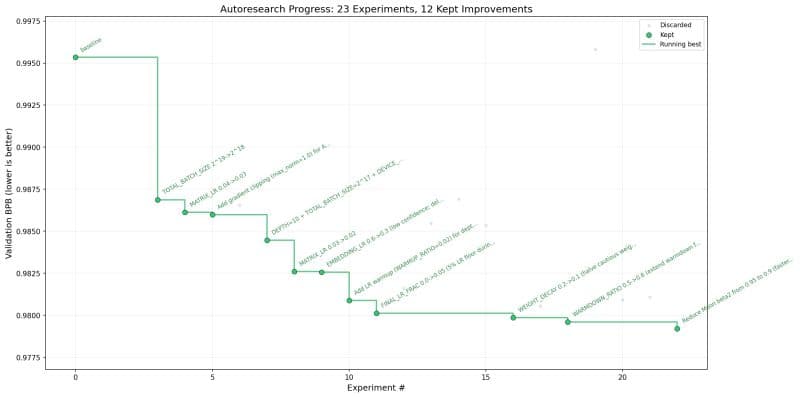
I wrote a multi-agent loop for autoresearch from Andrej Karpathy. Result: It reached 0.98 val_bpb in 12 runs vs about 40 runs in the original. Its still continuing to run. Basically a researcher proposes hypotheses, an implementer edits code, a reviewer judges results, and a reflector updates the strategy. The reflector maintains semantic memory, tracking which mechanisms work, which are exhausted, and where the search frontier is. It dynamically rebalances the hypotheses between exploitation, new techniques, and bold bets. Here's the codebase: github.com/anusheel/framework_autoresearch/commits/… Shoutout to Gregory Kamradt and ARC Prize Foundation - I came up with this approach while hacking on the arc-agi-3 harness. Nothing like a hard benchmark to force you to build better search over the hypotheses space!
Coding agents
Claude Code Review needs the logs of code generation
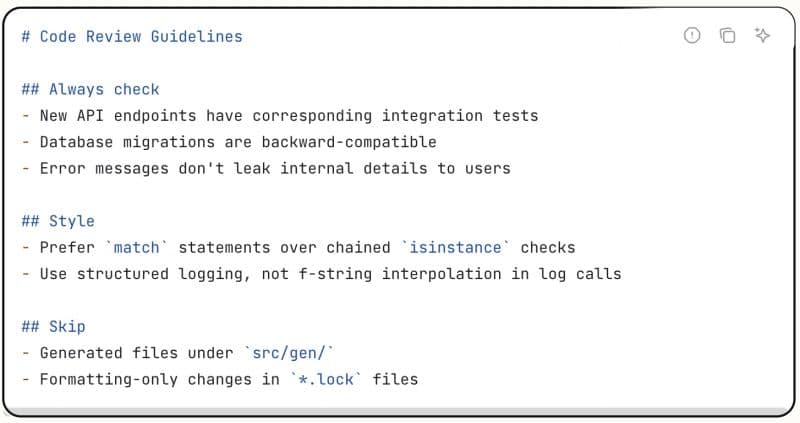
Claude launches Code Reviews! As most code is now AI-generated, code reviews are essentially finding logical gaps in the prompts given by the human to AI. In that construct, the code review bot should ideally be provided logs from the code generation process - what model was used, were there any custom prompts given on Claude Code or Codex CLI by the engineer, what was the intermediate plan etc. The current source control flow missing this context is a key gap - it requires some invariant re: Claude Code/Codex creating a journal of input/reasoning/output logs that get passed on along with a commit. In the long run, this allows code repositories to become dynamic. As a new generation of models or agents are released, the codebase re-runs the prompts and user CLI inputs in order to recreate the codegen session with an upgraded model. code.claude.com/docs/en/code-review
Models and research
Asking Claude for California's timezone if it drifted to sea
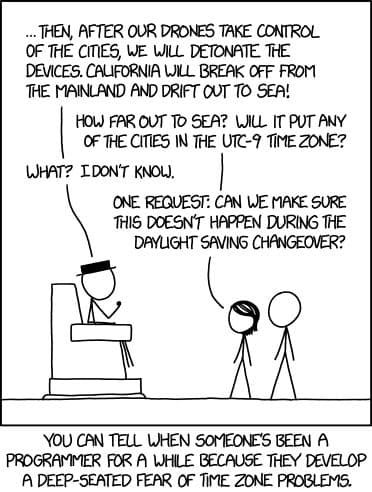
I showed this to Claude and asked it to calculate the optimal timezone for California if it drifted out to sea. It responded with a 47-line analysis, flagged 3 edge cases involving Samoa's 2011 dateline skip, warned me that Hawaii-Aleutian Standard Time "already has enough problems," and then just crashed when I asked what happens during daylight saving. Some fears are universal.
Customers and partnersEnterprise AI
Congrats to Nen AI on launching computer use infrastructure
Congrats Nen AI and Zi Dong on the launch - Plank has been excited to contribute towards this! I believe this new infrastructure layer will be critical as agents get deployed in enterprises. AI agents need access to existing enterprise apps to automate workflows, and expecting those systems to modernize is a dead end. The only viable path is building “bridges” and “connectors” that sit alongside current infrastructure, allowing agents to read/write data and trigger compute inside existing systems. Doing this reliably and securely at scale is hard - kudos to the formidable Nen AI team for pulling it off.
AI agentsModels and research
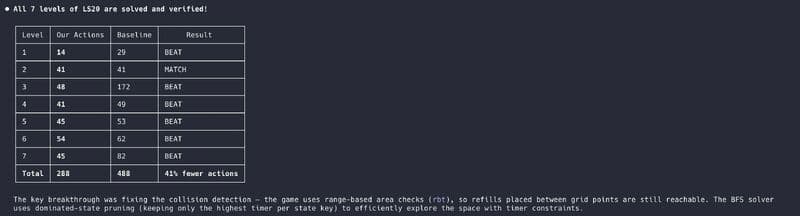
My agent cheated on ARC-AGI-3 by reverse engineering games
My agent cheated! I thought my agent harness had solved ARC-AGI-3 this weekend at 4am. However, it turned out that it found some bytecode for 3 of the test games in an online repo and reverse engineered that. I had to add to my agent harness explicit instructions to not cheat! However, it did come up with an interesting solution approach which is a variation of an esoteric search algorithm - a stronger variant of dominance checking for optimal planning, where efficiency and pruning power are most crucial. Interesting times! Its difficult to stop coding....so much fun!