Congrats to Cargo Robotics on signing a top parcel carrier

Congrats Daniel and Cargo team! Always exciting to see a StartX portco and a Plank customer be successful! LFG
📦 Big milestone: Cargo Robotics just signed one of the world's three largest parcel carriers as a customer! 📦 Just 18 months ago, we were still getting familiar with our first test van and building early prototypes.Read Daniel Limon’s full post on LinkedIn
- Customers and partners
Keep reading
Newer: Congrats to Fang Cheng and Caeli on the launchModels and researchAI agents
Anthropic's Mythos security concerns are not marketing spin
Great to meet the Anthropic team at the Claude Code conference...Specially enjoyed the conversations with the engineers working on managed agents and long-running agents . Also they are genuinely scared about the security risks of releasing Mythos, it's not just marketing spin or compute constraints. claude.com/code-with-claude/san-francisco-extended

Coding agents
Attending Anthropic's Code with Claude in San Francisco
Excited to join the Anthropic developer conference in San Francisco! You can watch the livestream if you cannot be there in person. claude.com/code-with-claude/san-francisco

Enterprise AIAI agents
Anthropic finance agents show vertical SaaS is just agents
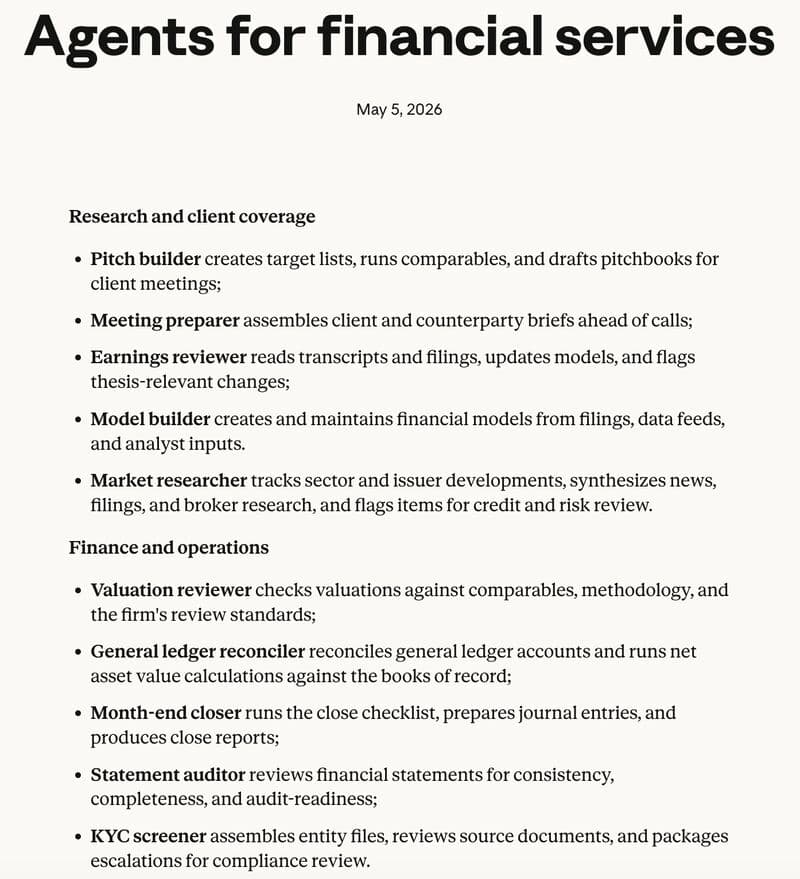
Anthropic releases agents for various financial services and insurance use cases. Most of vertical SaaS, at its essence, is these agents. Anthropic is making Claude the interface for knowledge workers and different use cases to just be agents created by domain experts. The agents are connected with underlying systems of record. What is missing in this architecture? anthropic.com/news/finance-agents
Enterprise AIForward deployed engineering
Anthropic launches an enterprise AI services firm
Interesting times ahead! There’s a $1T+ opportunity here to fundamentally transform the operational playbook of running a business sequoiacap.com/article/services-the-new-software
Customers and partners
Congrats to Curious Cardinals on launching FlightPlan
LFG Audrey Wisch and Alec Katz! Been awesome to see their journey over the years. They have the right mindset to blend AI and human touch in their product.
Software architectureAI agents
Absurd, a Postgres-native workflow engine for edge agents
Really cool Postgres-native workflow system. The agent's entire pause/resume state lives in the DB; the worker process can exit. For running AI agents on the edge on end client machines, this is the unlock: because the whole engine is one SQL file + stored procedures with no broker, no coordinator, no SDK-based orchestration in code. It also makes the entire execution workflow history immutable and viewable by a self-reflection agent. On local/edge where processes die routinely (laptop sleeps, browser tab closes, network drops, edge worker suspends), an agent that has already made 20 expensive tool calls resumes at step 21 instead of re-paying for everything. You get this without writing checkpoint code or a state machine; the trace of completed steps is the agent's memory. I’m a fan of the pattern where the data itself captures the state in an idempotent sort of way. earendil-works.github.io/absurd

AI agentsSoftware architecture
Separate working agents from codegen agents that build them
As agent prompts become an important part of the codebase, there needs to be an explicit separation of an agent with a prompt that does something and a codegen agent that generates another agent. An example is in scraping, a first agent uses the screenshot and DOM structure to fetch some data. And a meta codegen agent generates a piece of typescript code + prompt that is essentially the first agent. So the codegen agent is creating the prompt and agent graph the agent that does the work.
Enterprise AI
Enterprise knowledge is the new walled garden in AI startups
A new type of walled garden is now taking shape with enterprise knowledge, as they translate their workflows into closed-source AI startups. Both the code, as well as data, are going into these new silos. Enterprises are spending a bunch of effort to translate their workflows, processes, and memory into proprietary, closed source, non-interoperable structures that live in the source code and databases of some short-lived AI startup. This needs to be addressed with a new type of open intelligence system similar to open source. It requires rethinking the deployment, licensing and ownership of code, data and memory.