Anthropic finance agents show vertical SaaS is just agents

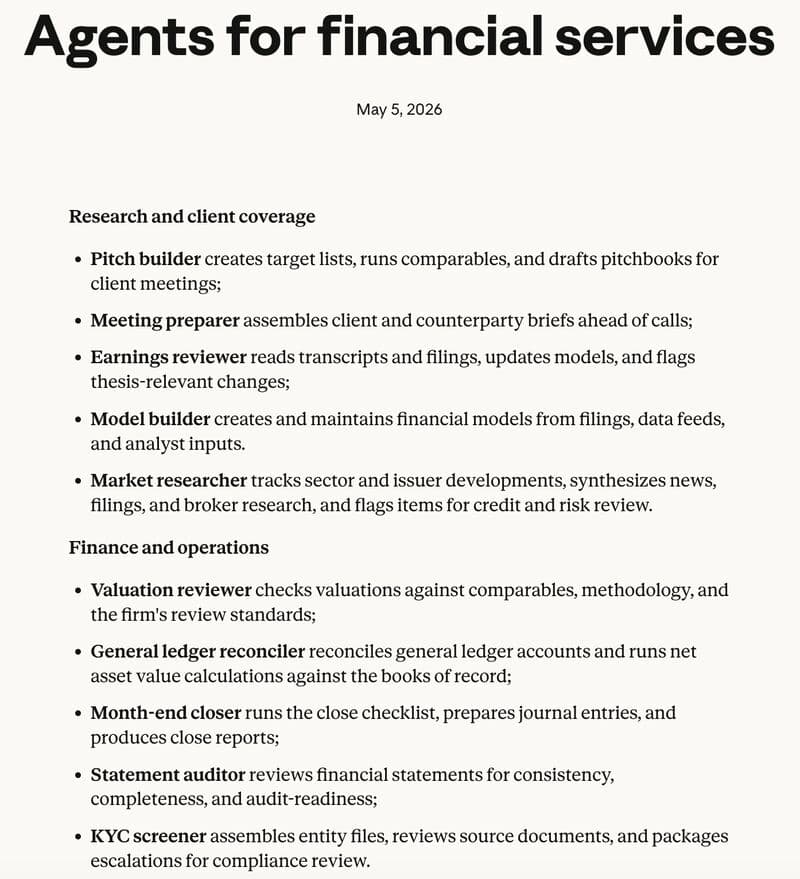
Anthropic releases agents for various financial services and insurance use cases. Most of vertical SaaS, at its essence, is these agents. Anthropic is making Claude the interface for knowledge workers and different use cases to just be agents created by domain experts. The agents are connected with underlying systems of record. What is missing in this architecture?
- Enterprise AI
- AI agents
Keep reading
Newer: Attending Anthropic's Code with Claude in San FranciscoEnterprise AIForward deployed engineering
Anthropic launches an enterprise AI services firm
Interesting times ahead! There’s a $1T+ opportunity here to fundamentally transform the operational playbook of running a business sequoiacap.com/article/services-the-new-software
Customers and partners
Congrats to Curious Cardinals on launching FlightPlan
LFG Audrey Wisch and Alec Katz! Been awesome to see their journey over the years. They have the right mindset to blend AI and human touch in their product.
Software architectureAI agents
Absurd, a Postgres-native workflow engine for edge agents
Really cool Postgres-native workflow system. The agent's entire pause/resume state lives in the DB; the worker process can exit. For running AI agents on the edge on end client machines, this is the unlock: because the whole engine is one SQL file + stored procedures with no broker, no coordinator, no SDK-based orchestration in code. It also makes the entire execution workflow history immutable and viewable by a self-reflection agent. On local/edge where processes die routinely (laptop sleeps, browser tab closes, network drops, edge worker suspends), an agent that has already made 20 expensive tool calls resumes at step 21 instead of re-paying for everything. You get this without writing checkpoint code or a state machine; the trace of completed steps is the agent's memory. I’m a fan of the pattern where the data itself captures the state in an idempotent sort of way. earendil-works.github.io/absurd

AI agentsSoftware architecture
Separate working agents from codegen agents that build them
As agent prompts become an important part of the codebase, there needs to be an explicit separation of an agent with a prompt that does something and a codegen agent that generates another agent. An example is in scraping, a first agent uses the screenshot and DOM structure to fetch some data. And a meta codegen agent generates a piece of typescript code + prompt that is essentially the first agent. So the codegen agent is creating the prompt and agent graph the agent that does the work.
Enterprise AI
Enterprise knowledge is the new walled garden in AI startups
A new type of walled garden is now taking shape with enterprise knowledge, as they translate their workflows into closed-source AI startups. Both the code, as well as data, are going into these new silos. Enterprises are spending a bunch of effort to translate their workflows, processes, and memory into proprietary, closed source, non-interoperable structures that live in the source code and databases of some short-lived AI startup. This needs to be addressed with a new type of open intelligence system similar to open source. It requires rethinking the deployment, licensing and ownership of code, data and memory.
Customers and partnersEnterprise AI
Congrats to Sentra on raising $5M for organizational memory
Congrats Andrey Starenky! It's been a blast building with you. Sentra has figured out the right architecture for organizational context and memory. Excited for the road ahead....LFG!
AI agents
Anthropic launches Claude Managed Agents
Anthropic launches managed agents. This allows a non-technical user to build an agent in their Claude code desktop app and deploy in the Anthropic cloud to make it live. With this release, Anthropic moves into the space of sandboxes and infrastructure in general. platform.claude.com/docs/en/managed-agents/overview
Coding agents
The product trap of harness engineering and agentic coding
Harness engineering and agentic programming are super addictive and fun, there's strong parallels with video gaming. However, this will lead to a lot of smart, non-technical folks building software just for the sake of it without clarity on user pain points. I call this the “product trap.” Building software is gratifying in the minutes and the hours people are building small tools for themselves, but the act of creating the software itself is not a substitute for solving real user pain points