Healthcare AI · Product layer
NOA: a multi-agent Medicare companion built on Claude
Navigage turns the fragmented US healthcare bureaucracy into a guided conversation with an AI assistant named NOA. The entire intelligence layer runs on Anthropic's Claude API, with Claude Opus 4.8 as the primary model.
navigage.ai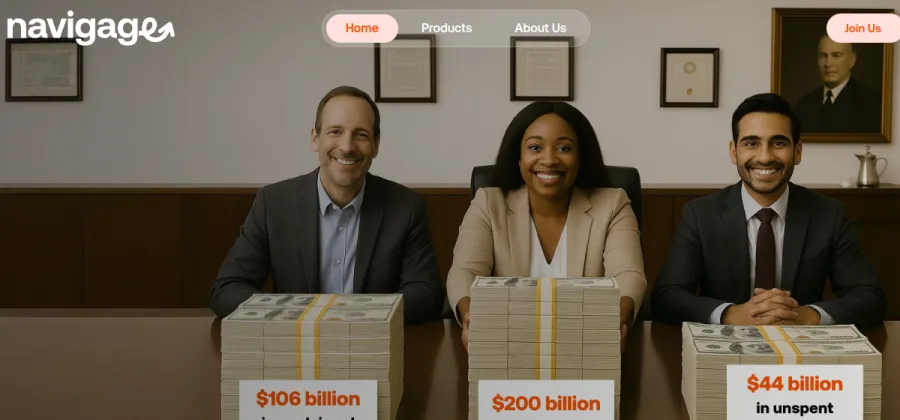
Industry
Healthcare · Medicare navigation
Primary model
Claude Opus 4.8
Architecture
Router + specialized sub-agents
1
Guided conversation, not a form maze
6+
Specialized sub-agents
Real-time
Intent, extraction & cost analysis
Navigage is an AI-powered platform that helps Medicare beneficiaries — predominantly older adults — understand their coverage, find providers, and make care decisions without having to decode the fragmented, confusing US healthcare bureaucracy on their own. The innovation is turning that process into a guided conversation with an AI assistant called NOA, and the entire intelligence layer runs on Anthropic's Claude API.
The problem
Medicare is notoriously hard to navigate: plans, coverage rules, provider networks, and out-of-pocket costs are scattered across systems that assume a level of fluency most beneficiaries never had a reason to build. For older adults especially, the cost of a wrong turn is real — a missed benefit, an unexpected bill, or care deferred because the path to it was too confusing.
A guided conversation, not a search box
Instead of asking users to become experts, Navigage lets them talk to NOA. The assistant meets people where they are, in plain language, and does the decoding for them — surfacing what a plan covers, who is in-network, and what a given decision will actually cost. Claude Opus 4.8 is the primary model behind that experience.
A multi-agent architecture
Under the hood, the architecture is multi-agent. A router agent interprets each user message and dispatches it to specialized sub-agents for costs, coverage, care, reminders, tasks, and coaching. Each sub-agent is equipped with its own tools — connected to plan and provider databases via tool use — so the model can reason over real, current data rather than generic knowledge.
Real-time language understanding
On the text users type, Claude performs several real-time analyses. Intent detection recognizes when someone is asking for a reminder, ending the conversation, or greeting the assistant — replacing brittle keyword heuristics with LLM classifiers that return structured output. The model also extracts clinical and behavioural facts such as date of birth, medications, comorbidities, financial sensitivity, and sentiment; judges confirmations; and estimates out-of-pocket costs for services a plan does not cover.
Advanced API capabilities at scale
To keep the experience fast and cost-efficient at scale, Navigage relies on advanced API capabilities — prompt caching, response streaming, structured output, and per-turn effort control. Together they let NOA feel immediate for the user while keeping the economics sound as usage grows.
A mature product layer, not a support chatbot
The result is a real, mature use case of Anthropic's technology as a core product layer. Claude is not a bolt-on FAQ widget here — it is the intelligence that reads intent, holds context, reasons over live data, and turns an intimidating bureaucracy into a conversation an older adult can actually have.
Stack
Put an embedded AI team on your roadmap
Forward-deployed engineers to deploy, AI-native engineers to build, and on-demand QA pods to validate, embedded with your team, starting the same day.