Healthcare operations
Intake that stops being retyping
Claim Health runs referral intake for 20 home health and hospice agencies. Claude drives the EMR screens that expose no API, reviews hospice documents for missing fields, answers operations questions from the agency's own procedures, and helps configure each new agency at onboarding.
claimhealth.com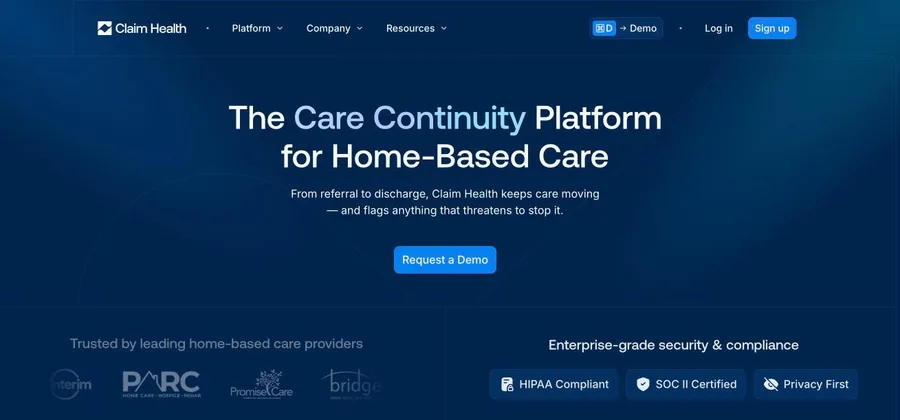
Industry
Home health & hospice · Healthcare operations
Models
Claude Sonnet 4.6 (navigation) · Haiku 4.5 (screen recognition) · Opus 4.8 (document QA) · Opus 4.7 and Opus 5 (configuration)
Interfaces
Claude API: Messages API, tool use, Computer Use
Architecture
EMR agents, hospice compliance QA, Chai operations assistant, onboarding configuration
Engineering
Team builds with Claude Code
~114,000
Claude calls across ~785 intake tasks in August 2026
~94%
of all model calls in the agent runtime
20 agencies
running referral intake on the platform
Home health and hospice agencies lose referrals and revenue to slow manual intake. Staff re-key referral data into electronic medical records, move between desktop and web systems that expose no APIs, and discover documentation gaps late, after the paperwork has already moved. Claim Health automates that intake for 20 agencies, and Claude does the parts that resist scripting: operating the screens, reading the documents, and explaining the procedures.
The problem
Intake is where the money leaks. A referral arrives, and someone retypes it into an EMR, field by field, across systems that were never designed to be integrated. Some are desktop applications. Some are web portals behind sessions that time out. Almost none offer an API worth building against.
Scripted automation covers the happy path and then stops. A dialog appears that wasn't there last week, a page loads slower than the script's wait condition allows, a layout shifts, and the run fails. Meanwhile the documentation side has its own failure mode: a hospice packet missing a required field is cheap to fix on the day it arrives and expensive to fix a month later.
Agents that take over when the script cannot
Claim Health's agent runtime uses Claude through Computer Use to operate EMR workflows directly. Claude Sonnet 4.6 drives screen navigation, deciding what to click and where the workflow stands. Claude Haiku 4.5 handles screen recognition and wait conditions, the high-frequency work of reading a screen and judging whether it is ready to act on.
The design point is the handover: scripted automation runs while it can, and the agents take over when it cannot proceed. A secondary provider sits behind Claude as fallback, so a provider incident degrades throughput rather than stopping intake.
In August 2026 that runtime made roughly 114,000 Claude calls across about 785 intake tasks, some 94% of all model calls in the agent runtime. Claude Sonnet 4.6 agent calls grew from around 47,000 in July, tracked from the 9th, to around 74,000 in August.
Compliance QA on hospice documents
Claude Opus 4.8 reads HFS forms and prior authorization packets and checks them against the fields those documents are required to carry. It has been running that review since July 2026.
The split here is deliberate. Referral data extraction runs on a separate provider; Claude is used for the judgement-heavy pass, reading a filled-out form and deciding whether it is actually complete. Catching a gap at intake is the difference between a phone call and a denied claim.
Chai, the operations assistant
Chai is an internal assistant for operations staff, running on Claude Sonnet 4.6 and Haiku 4.5 and grounded in the agency's own standard operating procedures, currently 22 published documents.
Grounding is the whole design. Intake rules differ by agency, payer and state, so an assistant answering from general knowledge would be confidently wrong in exactly the cases that matter. Chai answers from the procedures the agency actually published.
Onboarding a new agency
Bringing an agency onto the platform means describing its insurance mappings and its automation rules, work that used to be a long series of interviews and spreadsheets. Claude Opus 4.7 generates the insurance mapping descriptions, and Claude Opus 5 suggests automation rules during onboarding.
Both are drafts for a human to approve rather than configuration applied blind, which is what makes them useful: the slow part of onboarding is producing a first version, not correcting one.
The outcome
Across all AI models on the platform, not Claude alone, referral volume grew from roughly 600 a month in December 2025 to about 28,800 a month in August 2026 across 20 agencies, with around 146,000 referrals processed and about 30,000 patients admitted.
What that scale rests on is unglamorous: an agent that can finish a form when the script gives up, a reviewer that notices a missing field before it becomes a denial, and an assistant that knows this agency's rules rather than healthcare in general. Intake teams spend less time re-keying data and chasing paperwork, which was the point.
Stack
Put an embedded AI team on your roadmap
Forward-deployed engineers to deploy, AI-native engineers to build, and on-demand QA pods to validate, embedded with your team, starting the same day.